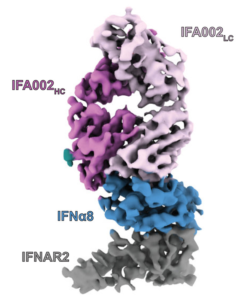

November 13, 2026 – In a study published in Immunity, researchers from the Institute for Research in Biomedicine in Bellinzona, Switzerland, together with collaborators at Zurich and Stanford University, identify human antibodies that neutralize interferon-α and show how combining them enhances their ability to block this key antiviral factor.
Interferon-α (IFN-α) is a protein produced by the human body that plays a crucial role in defending against viral infections. It acts as an alarm signal, activating mechanisms that help cells fight viral replication and limit the spread of viruses.
In some individuals, however, the immune system mistakenly produces autoantibodies against this protein. Unlike antibodies that recognize external pathogens, autoantibodies target components of the body’s own tissues or proteins. When they neutralize IFN-α, they prevent it from exerting its protective function, weakening antiviral defenses and increasing the risk of severe viral infections, such as COVID-19.
To better understand how these autoantibodies develop and acquire the ability to block IFN-α, an international research team co-led by Davide Robbiani (Institute for Research in Biomedicine, Bellinzona – affiliated with USI), Benjamin Hale (University of Zurich), and Christopher Barnes (Stanford University) investigated the evolution of the autoantibody response over time and analyzed the molecular characteristics of human monoclonal autoantibodies isolated from an affected individual.
By tracking the presence of these antibodies over time and mapping their molecular interactions, the team discovered that autoantibody responses often begin by targeting a single IFN-α subtype before gradually broadening to neutralize multiple subtypes. Structural analyses also revealed autoantibodies that bind to different IFN-α domains.
Crucially, when antibodies binding to different domains of IFN were combined in cell-based assays, they acted synergistically, increasing infection and triggering immune effector functions that potentially eliminate IFN-α-RESPONDING cells.
These findings provide a better understanding of how autoantibodies develop broad and cooperative activity, helping to explain why certain individuals may be more vulnerable to severe viral infections. They also open new perspectives for developing targeted therapeutic strategies against autoimmune diseases characterized by excessive IFN-α activity, where its blockade could be beneficial.
Link to the Scientific Article:
Human interferon-alpha autoantibody development broadens reactivity and enables functional synergy
Groen, K. Moritz, J. A. Vasquez, S. Rubio, A. A. Kuratli, R. Jones, D. Grafl, D. Motta, M. Fontana, S. Manning, J. Costagli, S. Simonelli, L. Thakur, R. Jarrossay, D. Tran, C. Lee, Y. E. Abela, I. A. Calmy, A. Hirzel, C. Kaufmann, D. E. Swiss, H. I. V. Cohort Study Gunthard, H. F. Kouyos, R. D. Barnes, C. O. Robbiani, D. F. Hale, B. G.
in Immunity (2026) Vol. pp