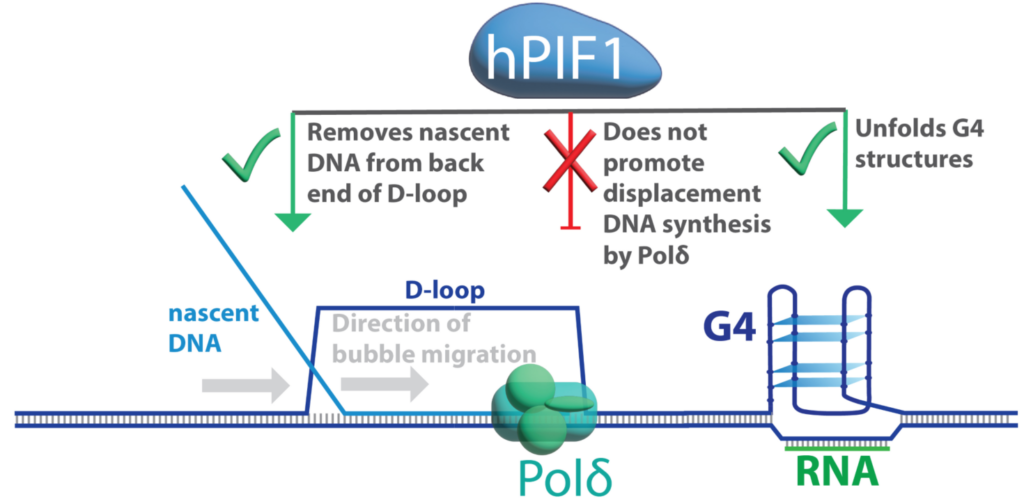
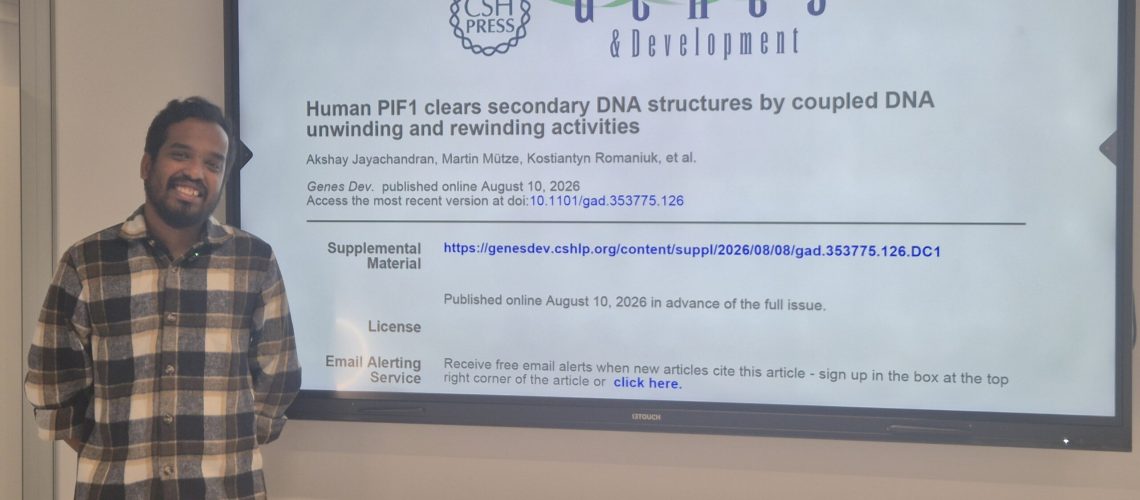
A study published in the journal “Genes and Development” by Petr Cejka group demonstrates a novel functional mechanism of human PIF1, a multifunctional DNA helicase involved in replication and repair. Unlike classical DNA unzipping helicase’s role, hPIF1 acts as a DNA translocase coupling local unwinding with rapid rewinding to resolve complex DNA secondary structures.
Human PIF1 has been assumed for a long time to behave like its yeast counterpart in cellular process such as break-induced replication, a repair mechanism to counteract genome instability. However, human PIF1 appears to be a weak and slow helicase. Using biochemical, single-molecule, structural modeling and in vivo experimental approaches, the authors showed that hPIF1 employs a different mechanism compared to its yeast counterpart. Indeed, human PIF1 uses a coupled unwinding-rewinding mechanism, which makes it function more as a comb rather than a canonical strand separating helicase. The work was primarily carried out by Akshay Jayachandran from the Cejka Laboratory at IRB (affiliated with USI) in collaboration with laboratories led by Ralf Seidel (Leipzig University), Ulrich Rass (University of Sussex) and Raphael Guerois (Université Paris-Saclay).
Link to the scientific article:
Human PIF1 clears secondary DNA structures by coupled DNA unwinding and rewinding activities
Jayachandran, A. Mutze, M. Romaniuk, K. Hudson, J. J. R. Dello Stritto, M. R. Guerois, R. Acharya, A. Braunshier, S. Reginato, G. Senoussi, I. Rass, U. Seidel, R. Cejka, P.
in Genes Dev (2026) Vol. pp