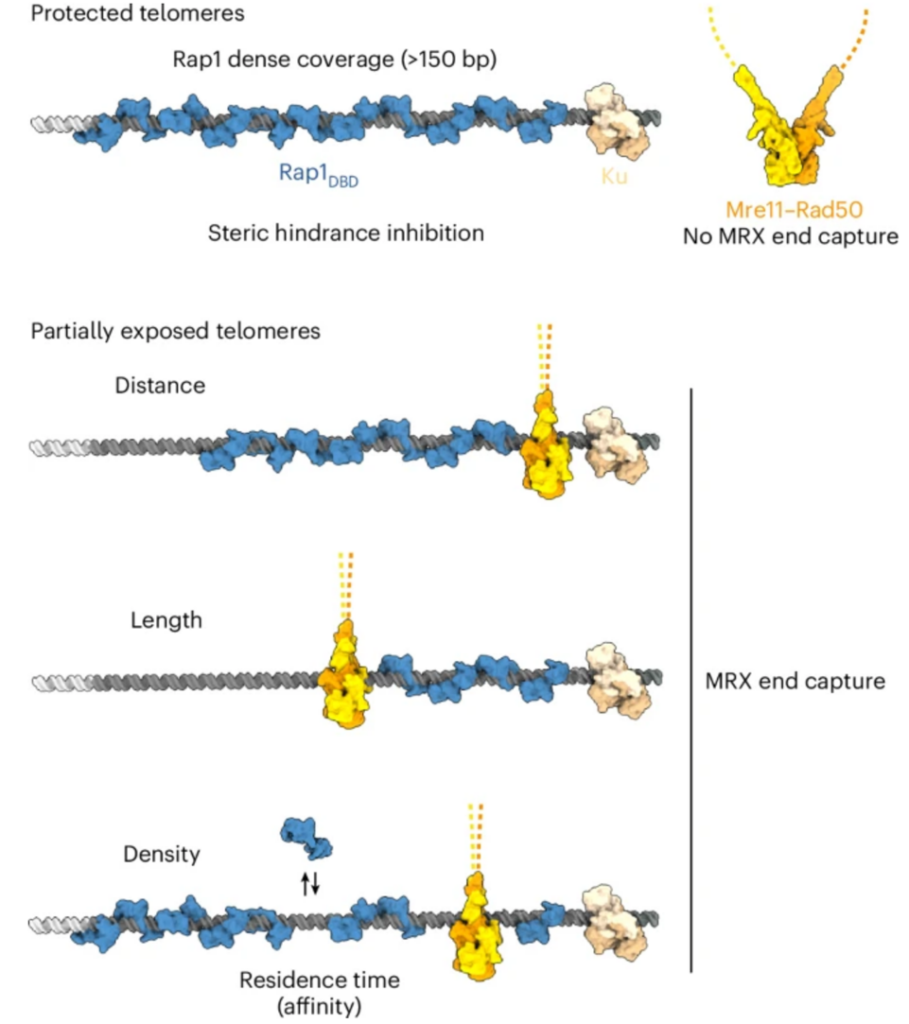

A collaborative paper published in Nature Structural & Molecular Biology by the group of Prof. Marcand (Paris) and Prof. Cejka (IRB Bellinzona) reveals how arrays of the telomeric protein Rap1 block MRX by steric hindrance, enabling cells to sense telomere length.
Telomeres protect chromosome ends, but when they become too short, cells must detect and respond to the threat. This study reveals how they do it: the MRX complex can sense the size of Rap1 protein arrays bound to telomeric DNA and uses this information to distinguish short from long telomeres. Longer Rap1-covered regions act as a physical barrier, blocking MRX activity through steric hindrance rather than direct protein interactions. As a result, they prevent harmful DNA repair events such as chromosome fusions and DNA resection. In contrast, short telomeres lose this protection, allowing MRX to trigger damage responses. These findings uncover a simple yet powerful mechanism by which cells measure telomere length and maintain chromosome stability, offering new insight into telomere homeostasis and the processes that drive cellular aging and senescence.
Giordano Reginato (IRB), Elda Cannavo (IRB) e Stefano Mattaracci (Paris) are joint first authors and Petr Cejka ( IRB) and Stèphane Marcand ( Paris) share corresponding authorship.
Rap1-mediated steric hindrance protects telomeres from MRX sensing